 Save

By Gene Jolley · Updated November 7, 2026 (EST). General source-based education, not clinically reviewed. I may earn a commission through shopping links, at no additional cost to you.
Two vitamins in one bottle does not make one simple yes-or-no answer. If you take warfarin, changing vitamin K intake is a care-team question—not a checkout choice. Here is the vitamin K2, warfarin and D3 checklist I would put beside the actual label before adding anything.
Make a five-line label card
- Exact product and strength: ____
- Vitamin D per serving: ____ mcg / ____ IU
- Vitamin K per serving and form: ____ mcg / ____
- Same nutrients in my other products: ____
- What my pharmacist or care team says to do: ____
Leave the last line blank until the conversation. A multivitamin and a separate D3-K2 bottle may repeat nutrients. Taking a combination pack does not make that overlap disappear. If you already use K2 with warfarin, do not abruptly stop because you read this article—contact your care team about any change.
For vitamin D, 1 mcg equals 40 IU. That conversion helps you add labels written in different units; it is not an instruction to increase intake.
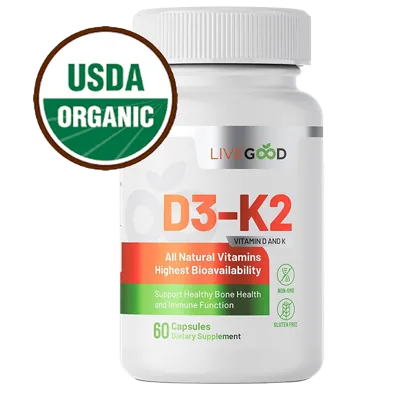
Read the D3-K2 product label and current variant, then read the current manufacturer label and buying options. I may earn a commission through that link, at no additional cost to you.
D3 and K2 are different nutrients
Vitamin K contributes to blood clotting and bone health. K2 refers to menaquinone forms of vitamin K. Vitamin D helps calcium absorption and has other functions. Putting both in one bottle does not mean everyone needs it or prove it prevents heart disease, protects arteries or cancels a medication risk.
“Blood thinner” is a broad description, not a single medicine. The warfarin/vitamin K issue should not be applied identically to every anticoagulant. Nor should another drug be assumed safe with an entire blend without review.
Prepare a label sheet
- Exact product and variant, including any strength number.
- Vitamin D amount in micrograms and IU per serving.
- Vitamin K amount in micrograms and listed form.
- Capsules per serving and actual use.
- Vitamin D and K in multivitamins and other products.
- All prescriptions and recent changes.
Bring full facts-panel photos and other ingredients. A product name or old pack photograph is not enough to calculate your intake.
Questions for your pharmacist or clinic
- Does this exact K2 product conflict with my warfarin plan?
- What should I do before changing vitamin K intake, including stopping a supplement I already use?
- Would an approved change require coordinated monitoring, and who arranges it?
- Does my multivitamin already provide these nutrients?
- Is there a reason for me to take vitamin D, and what amount would you advise?
- Do my medicines or conditions change that answer?
- Would testing change my care?
- Whom should I contact about a problem?
Testing is not a universal instruction
NIH explains that vitamin D status can be measured with a 25-hydroxyvitamin D blood test. That is not a recommendation for everyone to undergo routine screening. Whether to test and how to interpret results are clinical decisions. Symptoms and a shopping guide cannot diagnose deficiency.
Check duplication before adding another bottle
Too much vitamin D can be harmful. NIH lists an adult upper limit of 100 mcg (4,000 IU) daily from all sources unless a clinician recommends otherwise. This is not an intake target. Add current products and discuss the result with a qualified professional.
The Daily Essentials review explains why a multivitamin plus separate D3/K2 needs a duplication check. Bring the full pharmacist checklist and use the private tracker for questions. This page is not a reason to start a product or alter a prescription.
A useful next step
Check overlap inside the three-product pack. If professional review leaves you with a product you already intended to order, you can check the current free-bottle-with-order terms. It is optional, requires a qualifying purchase and is not a reason to add an unsuitable supplement. I may earn a commission through my links, at no additional cost to you.
Frequently asked questions
Can I add K2 while taking warfarin?
Ask your anticoagulation care team before adding, stopping or changing K2. Do not change your prescription yourself.
Do all blood thinners have the same interaction?
No. Ask a pharmacist to review the exact medicine and complete supplement formula.
Does everyone need a vitamin D test?
No universal testing recommendation is made here. Ask whether testing would change your individual care.
Sources
NIH ODS vitamin K and vitamin D, consulted November 7, 2026 (EST). No medical review or individual assessment performed.